

| In This Article: Email filtering alone no longer stops many phishing attacks targeting modern businesses. Readers will learn how layered cybersecurity solutions work together to block threats before they disrupt operations or expose sensitive data. |
Phishing remains a costly threat for businesses of all sizes, often leading to downtime, compromised accounts, recovery expenses, and lost productivity.
Attackers now rely on convincing email spoofing, fake login pages, QR-code scams, and AI-assisted social engineering campaigns that can trick employees into sharing credentials or transferring sensitive data. Business leaders and IT teams often find that traditional spam filtering alone no longer stops modern phishing attempts.
Strong cybersecurity solutions for businesses now rely on multiple layers of protection working together across email, endpoints, identity management, employee education, and network monitoring.
Why Businesses Struggle To Spot Phishing Attacks
Over the past several years, cybercriminals have refined their tactics, making fraudulent emails, fake login pages, and impersonation attempts much harder to recognize quickly.
The damage has been devastating, with the FBI reporting more than $16 billion in cybercrime losses in 2024, with phishing and spoofing remaining among the most frequently reported threats.
Attackers frequently impersonate vendors, executives, financial institutions, and cloud platforms through spoofed domains and cloned login portals. Microsoft’s Digital Defense Report noted growing use of adversary-in-the-middle phishing techniques that capture authentication sessions and bypass older security controls.
Security teams regularly encounter phishing messages that appear professionally written and closely match legitimate branding.
Some campaigns now arrive through collaboration tools, text messages, or QR codes sent through email attachments. APWG documented more than one million phishing attacks during the first quarter of 2025 alone, including a major increase in QR-code phishing activity.
Many small and midsize businesses struggle because phishing attacks rarely target just one weak point. When cybercriminals obtain even one valid login, they may be able to move deeper into business systems and create serious operational, financial, or data security damage.
Advanced Email Security Still Plays a Major Role
 Email security for businesses remains one of the first lines of defense against phishing campaigns. Modern filtering platforms inspect links, attachments, sender reputation, and suspicious behavior before messages ever reach an inbox.
Domain authentication technologies, including SPF, DKIM, and DMARC, help companies reduce email impersonation and improve the reliability of inbound message screening. CISA explains that these controls help reduce spoofed emails by validating authorized senders and rejecting fraudulent messages that fail authentication checks.
Our extensive experience across managed security environments shows that businesses often overlook configuration gaps within Microsoft 365 and Google Workspace tenants. Weak email policies, excessive forwarding permissions, and outdated authentication settings frequently create opportunities for attackers.
Multi-Factor Authentication Reduces Credential Theft
Password theft remains one of the most common phishing outcomes. Phishing protection becomes stronger when multi-factor authentication (MFA) requires a code, prompt, token, or biometric check before access is allowed.
CISA recommends phishing-resistant MFA for higher-risk accounts because attackers increasingly target traditional push notifications and SMS verification methods.
MFA Methods That Offer Stronger Phishing Protection
Businesses moving beyond text-message verification often adopt stronger authentication methods, such as:
- Hardware security keys for privileged users
- App-based authenticators with number matching
- Biometric authentication using fingerprint or facial recognition
- Conditional access policies tied to device trust
- Risk-based login verification for unusual sign-in attempts
Organizations with remote employees and cloud applications often gain better visibility when MFA integrates directly with centralized identity platforms.
Businesses that manage remote employees, cloud applications, or vendor portals often gain stronger visibility when MFA policies connect with centralized identity management platforms.
Security teams can then review login anomalies, block suspicious sign-in attempts, and restrict risky devices from accessing sensitive systems.
Employee Cybersecurity Training Helps Limit Human Error
Human behavior still plays a major role in phishing success rates. Employees working quickly through crowded inboxes may click on malicious links before recognizing warning signs.
Effective employee cybersecurity training goes beyond giving basic annual compliance presentations. Frequent phishing simulations, brief awareness sessions, and practical reporting procedures can all help employees recognize suspicious behavior faster.
Real-world security operations often reveal the same pattern during investigations following an incident. Employees usually want to report suspicious messages, though many organizations fail to provide a simple reporting process.
Faster reporting gives IT teams valuable time to isolate threats before additional accounts become compromised.
AI Cybersecurity Tools Improve Threat Detection
AI cybersecurity tools help security teams analyze massive amounts of activity data in real time. Modern security platforms can detect unusual login patterns, abnormal endpoint activity, suspicious file behavior, and phishing indicators that traditional rule-based tools may miss.
Microsoft reports screening roughly 5 billion emails daily for phishing and malware threats, highlighting the scale at which automated analysis has become necessary. AI-assisted monitoring also helps businesses prioritize serious alerts and reduce time spent reviewing false positives.
Endpoint security solutions add another defensive layer by monitoring laptops, servers, and mobile devices for ransomware behavior, credential theft attempts, and malicious downloads.
Real-time endpoint detection can quickly identify suspicious activity, helping stop malware delivered via phishing before it reaches additional systems.
Zero-Trust Security Limits Damage After a Compromise
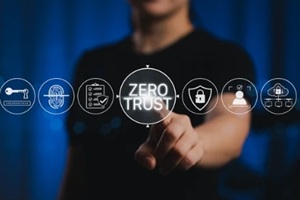
Zero-trust security phishing protection focuses on continuous verification rather than automatic trust. NIST describes zero trust as a security model that requires authentication and authorization before granting access to resources.
Least-privilege access policies, network segmentation, device validation, and conditional access controls help reduce the damage tied to compromised accounts. Attackers who gain access to a single user account encounter additional barriers that limit their lateral movement across the environment.
Businesses operating in regulated industries often benefit from combining zero-trust policies with continuous monitoring and incident response services.
Security teams can quickly identify unusual account activity, isolate compromised systems, and begin remediation before operations experience widespread disruption.
Building a Layered Phishing Defense Strategy
Successful phishing protection solutions rely on layered security rather than one standalone product. Email filtering, phishing-resistant MFA, employee education, endpoint protection, AI-assisted monitoring, and zero-trust access controls each reduce different forms of risk.
Advantage.Tech helps organizations strengthen their business cybersecurity solutions through proactive monitoring, endpoint protection, network security, compliance guidance, and incident response support that’s customized to meet everyday operational requirements.
Businesses looking to reduce phishing exposure and strengthen long-term operational stability can contact our team today to discuss a security strategy that’s aligned with their current environment and risk profile.