

SIP Trunking Services
Session Initiation Protocol (SIP) trunking delivers phone service over an internet connection instead of traditional phone lines, connecting your existing Private Branch Exchange (PBX) to a voice provider that routes calls to the public telephone network. Advantage Tech’s cloud phone systems team provides SIP trunking services that allow you to pay for the number of calls your team needs, rather than paying for fixed circuits regardless of their use.
What Is SIP Trunking?
SIP trunking is a technology that replaces your physical, copper phone lines with a virtual, internet-based connection that links your business phone system to the public telephone network, allowing you to make and receive calls through your existing data network.
While SIP trunking can be a standalone service, it can also be part of a broader Unified Communications as a Service (UCaaS) system. UCaaS combines Voice over Internet Protocol (VoIP), video, messaging, file sharing, conferencing, and similar capabilities under a single roof, and SIP trunking is the part of that system that connects voice calls to the public telephone network.
SIP trunking services are a good fit for companies that want to maintain control of their PBX, perhaps because they have a complicated switchboard that they have fine-tuned for years, but still want the cost savings and efficiencies that internet-based call paths allow.
Core Features of Advantage Tech’s SIP Trunking Services
Cut your telecom costs and scale your call capacity with secure SIP trunking that fits your existing phone system.
Carrier-Grade Voice Quality
Voice traffic travels over prioritized network paths across multiple upstream carriers, so conversations stay clear and connected. If one route degrades or fails, calls reroute automatically, keeping your phones online through outages that would strand a single-carrier connection.
Flexible Channel Capacity
Add or remove call channels as your business changes. Capacity is provisioned in software, not physical circuits, so you can scale without new hardware, new wiring, or a technician visit on site. Open a new location, staff up for a seasonal rush, then scale back as business slows without paying for capacity you no longer use.
Number Porting and DID Management
Keep the numbers your customers already know. Advantage Tech manages the migration and porting from your current carrier, then you assign direct inward dial (DID) numbers to ring a person or department directly across any location, in any area code you need.
Failover and Redundancy
Should your internet connection fail, calls reroute automatically to a backup circuit, another office, or your team’s mobile phones, based on rules you set in advance. Customers reach a person instead of a busy signal, even with the building offline.
Compatibility With Existing PBX Systems
SIP trunking uses a common language that nearly every phone system can communicate in. This allows your trunk to connect to what you already run, whether an on-premise PBX or a cloud-based platform, without replacing or writing off equipment that works and without having to retrain staff on new equipment.
Security and Fraud Prevention
Advantage Tech encrypts your voice traffic with Transport Layer Security (TLS) and Secure Real-Time Transport Protocol (SRTP), preventing your calls from being intercepted in transit. Continuous monitoring, international destination blocking, and per-account spend limits catch toll fraud early.
Advantage Tech’s Approach to SIP Trunking
We assess your infrastructure and needs, handle number migration and porting to minimize business disruption, and provide ongoing support.
Infrastructure Assessment
Our discovery process starts with a review of your current systems, including your PBX make, model, and firmware, your peak call volume, and whether your network can prioritize voice traffic. From your peak number of concurrent calls, we can determine how many channels you need and scope the service to your use.

Configuration and Number Porting
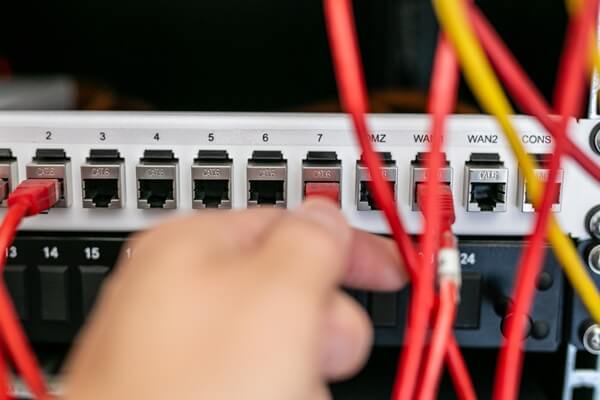
Our engineers configure the trunk on your PBX, set the firewall and security rules that keep it protected, and build the call routing your business depends on. We submit the port requests, coordinate the cutover with your current carrier, and test every number before you go live.
Ongoing Monitoring and Support
We monitor call quality and trunk uptime continuously so problems surface on our side before they reach your team. When we also manage your network, that visibility extends across the full call path, preventing a quality issue from becoming a debate between your phone vendor and your IT vendor.

Frequently Asked Questions
What Is the Difference Between SIP Trunking and a Cloud PBX?
While SIP trunking replaces your phone lines and is the connecting layer between your system and the public telephone network, a cloud PBX replaces your phone system. With SIP trunking, you keep your existing PBX on site and buy only the connection to the phone network. With a cloud PBX, the provider runs the entire phone system, and you pay per user each month. Companies with a working PBX often choose trunking.
Can SIP Trunking Work With Our Existing On-Premises PBX?
Yes, most business phone systems built in the last decade support SIP natively, and older systems can usually connect through a gateway that translates between formats. Compatibility does depend on your PBX’s make, model, and firmware, which is why we verify it during the infrastructure assessment before recommending a configuration.
Is SIP Trunking Secure for Regulated Industries?
Yes, when configured correctly SIP trunking is secure for regulated industries. Encryption protects call signaling and audio in transit, and access controls restrict who can place calls on your trunk. However, to achieve a HIPAA compliant communication network, for example, the entire environment, rather than only the trunk, has to be properly configured, secured, and monitored.
How Long Does It Take to Set Up SIP Trunking?
How long an SIP trunking setup takes depends largely on number porting. Generally, after the discovery process has been done and the plan laid out, trunk configuration might take days. But the time to port your existing numbers to the new service is set by your current carrier’s timeline. This might be two to four weeks, or longer for large number blocks or multiple locations. We map the schedule during the infrastructure assessment, once we understand your call volume and setup.
Contact Us for SIP Trunking Services
Whether you’re keeping a PBX you’ve fine-tuned for years or planning a new environment, Advantage Tech can scope SIP trunking around how your business actually uses its phones. Contact us online to schedule a consultation and we’ll walk you through our process from an assessment of your network to a recommendation that meets your needs.