

 Many AI products marketed to small businesses are no-code, plug-and-play tools, but they still come with operational costs the company must bear. Subscription fees, the learning curve users need on a new platform, and the staff hours spent reviewing AI-generated output all factor into the real price.
A small business doesn’t need a data science team to use these tools, but it does need to know which tools save more in time or revenue than they cost to run. The seven use cases below are the easiest to measure, and a business that already works with a managed IT provider likely has most of the infrastructure these tools need in place.
In This Article:
|
Customer Support Triage
AI features now built into most help desk software can classify incoming requests by topic and urgency. The software can then resolve repetitive requests such as password resets, order-status checks, and return-label generation, without routing them to a person.
When a request does require human attention, the system passes the full conversation history to the agent so the response starts with context instead of questions. The metric to track is the percentage of tickets closed without escalation. That percentage translates directly into staff hours recovered per week, and it is visible in the first 30 days after the system is operational.
Invoice and Expense Processing
AI-based accounting tools extract line items, tax figures, and vendor details from scanned invoices using optical character recognition paired with classification models. The tools can then match the extracted data against existing purchase orders and flag discrepancies before anyone opens a spreadsheet.
For a business that processes 200 invoices a month, reducing manual entry from 15 minutes per invoice to a two-minute review saves roughly 43 hours of staff time per month. That difference is measurable on the first billing cycle after deployment.
Marketing Audience Segmentation
The AI features built into platforms most small businesses already use, including Mailchimp, Meta Ads, and Google Ads, can segment audiences by purchase behavior and engagement patterns rather than demographics alone.
A retail business sending one promotional email to its entire list can instead split recipients into groups based on what each segment purchased in the last 90 days, then generate subject-line and copy variations for each group. The metric is conversion rate by segment compared against the unsegmented baseline, measured campaign by campaign.
Scheduling and Administrative Workflows
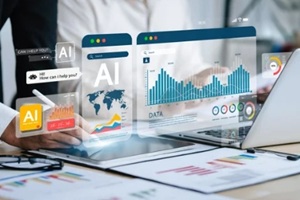 AI scheduling tools read natural-language requests, check availability across multiple calendars, account for time zones, and propose meeting slots without the back-and-forth that coordination traditionally requires.
Beyond calendars, AI-powered workflow tools can route incoming requests to the correct department, generate status-report drafts from project management data, and compile time-tracking summaries that previously required manual assembly. The time these tasks consume is often invisible because no single one takes long, but in aggregate the hours add up across a team.
Cybersecurity Threat Detection
AI-based endpoint detection and response tools establish a behavioral baseline for every device and user account on a network. When an account that normally accesses a small number of file shares begins pulling data from a dozen directories at a strange time of day, the system flags the anomaly before a signature-based tool would recognize it.
This layer of monitoring is especially relevant as AI-generated phishing messages become harder to distinguish from legitimate email. The metric is mean time to detect, which behavioral analysis can compress from days to minutes for anomalies that don’t match a known signature.
Employee Onboarding Automation
AI-powered onboarding tools connect to the HR, IT, and payroll systems a company already uses and can turn a single status change into a sequence that previously required coordination across three or four departments. For example, when a candidate accepts an offer, the tool can provision a company email and software licenses, enroll the new hire in payroll, schedule orientation sessions, and assign a training track based on the role, without a person chasing each step through email.
The metric to watch is time from accepted offer to fully provisioned employee, which for many small businesses drops from days to hours. The secondary metric is how many manual handoffs the workflow eliminates, because each one is a point where onboarding might stall or a step might be missed entirely.
Sales Pipeline Intelligence
Customer relationship management (CRM) platforms with built-in AI can rank inbound leads based on engagement signals, pages visited, emails opened, and proposals downloaded, along with company size and similarity to past closed deals. Sales teams then work the highest-ranked leads first rather than the newest or the ones assigned by default.
Forecast accuracy also improves when the model weights pipeline movement against historical close rates rather than relying on each representative’s subjective estimate. The two numbers to watch are conversion rate per rep-hour and forecast variance at quarter-end.
These predictive features require a baseline volume of clean data, often hundreds of closed deals and thousands of tracked leads. To train the AI model effectively, businesses need disciplined CRM data hygiene.
Getting Started With One Workflow
The U.S. Chamber of Commerce reports that 63% of small businesses adopting AI rely on externally developed tools rather than custom-built systems. The practical starting point is to identify the process that costs the most staff hours per dollar of revenue, measure the current time and error rate, deploy one tool against that process, and measure again after 60 days.
 Advantage Tech helps small businesses identify where AI-powered tools can lower operational costs while meeting industry security and compliance standards. Our AI support services are backed by an engineering team that includes CISSP-certified professionals, and Advantage Tech is a Service Organization Control 2 (SOC 2) certified provider.
Contact Advantage Tech to schedule a consultation and determine which workflows in your operations are candidates for AI and how to deploy them with the right protections.